
When bookings slow down, most hosts reach for the same three levers. Drop the nightly rate. Add another amenity. Start scrolling listings for the next property.
Sometimes that's the right move. But more often than you'd think, the property is fine. The marketing isn't.
Your STR can have beautiful design, five-star reviews and a location people would fly across the country for, and still sit empty on a Tuesday because the guests who'd love it never saw it. That's not a property problem. That's a visibility problem. And no amount of new throw pillows fixes it.
Here's how to tell the difference, and what to do about it.
Start with where guests drop off
Before you change anything, look at where you're losing people. Your platform dashboards show views, clicks and bookings. Each drop-off points to a different fix, and "lower the price" only solves one of them.
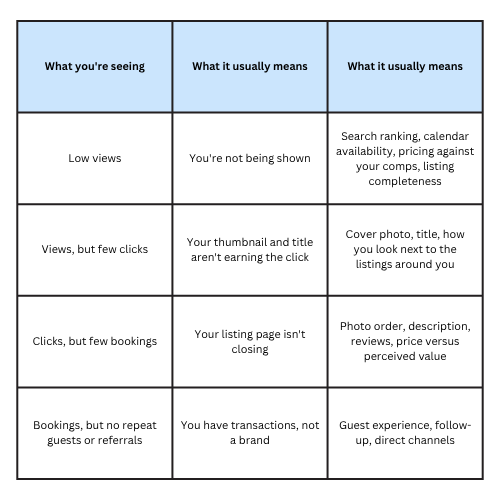
Three of those four rows are marketing problems. Most hosts treat all four as pricing problems.
Your listing is an ad. Treat it like one.
Your listing isn't a description of a property. It's an advertisement competing for a few seconds of attention in a crowded search grid.
Your cover photo is the most valuable real estate you own. It decides whether anyone sees the rest. Pull up your market as a guest would and look at your thumbnail next to everyone else's. Does it stop the scroll, or blend in?
Your first five photos should tell a story, not take inventory. Lead with the feeling of the stay, then the spaces that sell it. Nobody books because of the hallway.
Your title should say who the stay is for. "Charming 3BR Near Downtown" describes half the listings in your city. "Walkable Downtown Loft for Girls' Weekends" tells the right guest they've found their place.
Know exactly who you're marketing to
"Everyone" is not a guest. When you try to appeal to everyone, you end up memorable to no one.
Pick the guest you most want to book. Remote workers. Bachelorette parties. Families with toddlers. Golf trips. Once you know, every decision gets easier: which photos go first, which amenities you highlight, what your description promises and where you show up online.
The hosts who win aren't always the ones with the nicest property. They're the ones whose listing makes a specific guest think, "This was made for me."
Stop renting your entire audience
If every booking comes through a platform, you don't own your business's most valuable asset: the relationship with your guests. You're renting it. And the landlord can change the rules, the algorithm or the fees whenever they want.
You don't have to leave the platforms. You do need something you own alongside them. That might be a direct booking site, an email list built from your direct and repeat guests, a social presence that shows what staying with you actually feels like, or partnerships with local businesses that send guests your way. Build it within each platform's rules, but build it.
Direct bookings don't start with a booking engine. They start with guests who know your name.
Become known, not just listed
The real question isn't "How do I post on Instagram?" It's "How do I become known?"
A brand is the reason a guest remembers you, recommends you and searches your name instead of a zip code. It's a consistent name, look and voice across every channel. It's one signature detail guests talk about after checkout. It's content that shows the stay, not just the square footage.
Listed properties compete on price. Known properties compete on preference.
Your 30-minute marketing audit
Block off half an hour this week and work through this list:
Pull your last 90 days of views, clicks and bookings, and find your biggest drop-off
Search your market as a guest and screenshot your thumbnail next to your top five comps
Rewrite your title for one specific guest
Reorder your first five photos so they tell a story
Rewrite the first three lines of your description to lead with the experience
Count how many past guests you could reach today without a platform
Choose one channel you own and commit to building it for the next 90 days
If the audit shows a real property problem, fix the property. But if it shows a marketing problem, you just saved yourself a price cut, an amenity budget or a down payment.
Don't immediately add another door. Make the doors you already own work harder.
This is the kind of work we dig into together at Level Up Your Listing: real listings, real numbers and frameworks you can put to use the week you get home.