
7 Things You Should Automate Before You Buy Another Property
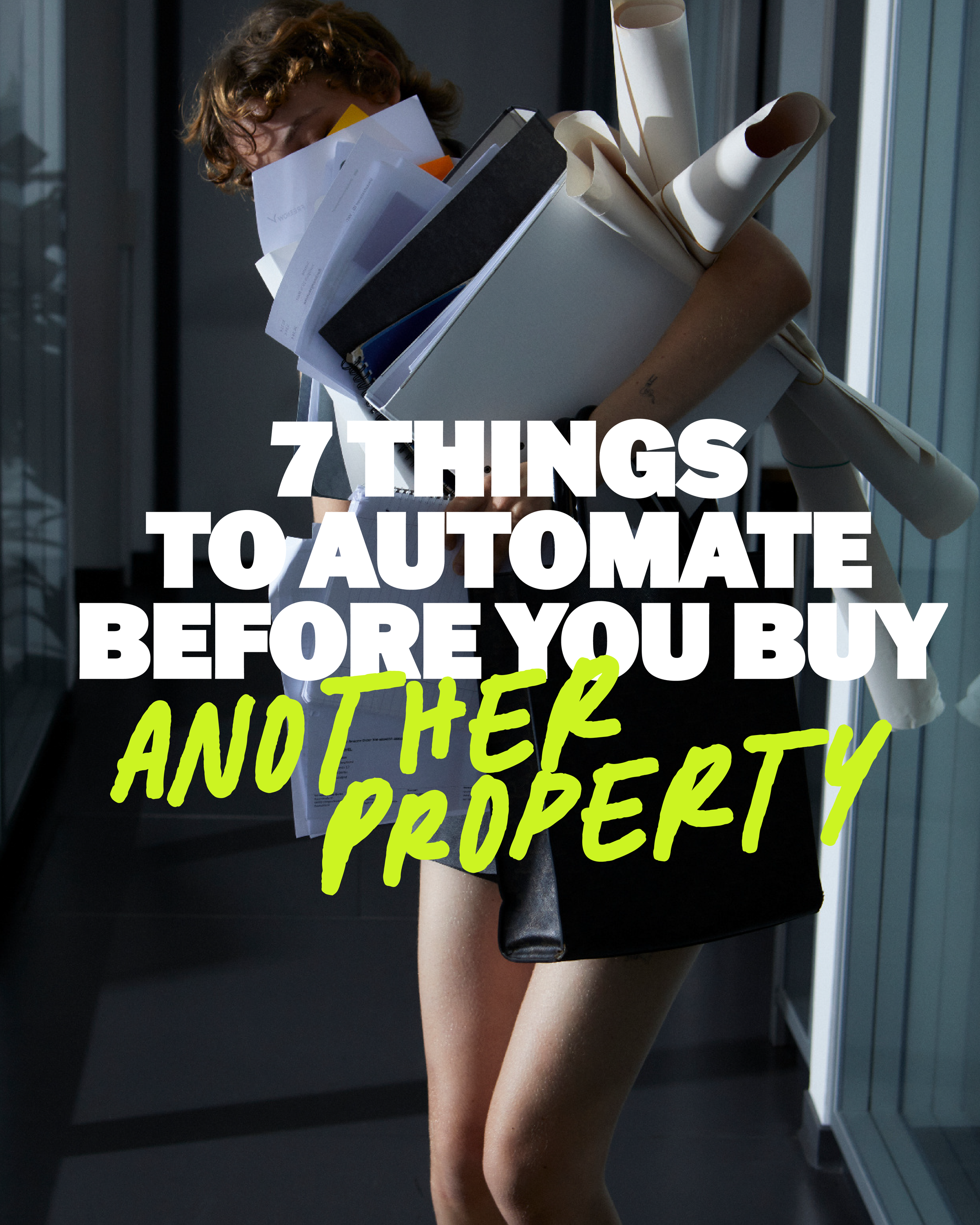
There’s a point in every short-term rental business where growth starts to look a little different.
In the beginning, adding another property feels like the obvious next move. More doors. More bookings. More revenue.
But eventually, more properties can also mean more guest messages, more cleaners to coordinate, more supplies to order, more maintenance calls, more pricing decisions, and approximately 47 more tabs open on your laptop.
So before you start scrolling Zillow for property number five, ten, or twenty, there’s another question worth asking:
Could my current portfolio run without me for a week?
Because adding another property to a messy operation doesn’t create freedom. It just creates a bigger messy operation.
Before you acquire, automate. Here are seven places to start.

1. Guest Communication
If you’re typing the Wi-Fi password into a guest message for the 400th time, we need to talk.
A huge portion of guest communication is predictable, which makes it one of the easiest places to automate.
Booking confirmations, pre-arrival information, check-in instructions, mid-stay check-ins, checkout reminders, and review requests can all be built into your guest journey ahead of time.
And if you’re using a platform like Lodgify, a lot of this can live in one place, with automated guest messaging and booking workflows taking repetitive tasks off your plate.
The goal isn't to make your guest experience feel robotic. It’s actually the opposite.
Automate the predictable so you have more time to be personal when it matters.

2. Cleaning + Turnover Management
A guest books. They stay. They leave.
You shouldn't have to personally start the cleaning process every single time.
Your reservation calendar should connect to a clear turnover system that notifies your cleaners, communicates schedule changes, provides a standardized checklist, and gives your team a way to flag damages, missing inventory, or maintenance issues.
The dream workflow?
Guest checks out → turnover happens → property is ready for the next guest.
And you didn't have to send six texts to make it happen.
As your portfolio grows, this becomes less of a convenience and more of a necessity.
3. Dynamic Pricing
If you're still manually deciding what Saturday night should cost, it's time to hand over some of the work.
Dynamic pricing tools can adjust your rates based on demand, seasonality, local events, booking windows, occupancy, and other market factors while still allowing you to establish your own guardrails.
Set your minimums. Create your minimum-stay rules. Build strategies around last-minute bookings and high-demand weekends. Then review the bigger picture.
Automation doesn't mean you never look at your pricing again. It means you stop making every single pricing decision yourself.
Your job is revenue strategy, not babysitting Tuesday night's nightly rate.
And on the topic of making your tech do more of the heavy lifting: we see you, Lodgify. 👀 Get to know more about what Lodgify can do for your STR business at LUYL 2027.

4. Maintenance Requests
Every host knows the message.
Hey! Quick question. The garbage disposal is making a weird noise…
And suddenly your entire afternoon belongs to a garbage disposal.
Maintenance will always be part of owning property, but coordinating every maintenance issue yourself doesn't have to be.
Build a system for how issues are reported, who receives them, which vendors are contacted, what qualifies as an emergency, and how much your team can spend without needing your approval.
Preventative maintenance can be systemized too: HVAC servicing, air filters, pest control, pools, landscaping, appliance checks, and all those little things that become very expensive when everyone forgets about them.
The goal isn't a maintenance-free portfolio.
It's a portfolio where every maintenance request doesn't automatically become your problem to solve.
5. Inventory + Restocking
Toilet paper should not be taking up CEO-level brain space.
Standardize the supplies you use across your properties wherever possible. Set minimum inventory levels. Create recurring orders for predictable supplies. Give cleaners or property managers an easy way to flag what's running low.
The more properties you own, the more valuable standardization becomes.
Because five houses with five different coffee makers, five different sheet systems, and five completely different supply closets isn5. Inventory + Restocking
Create a system now that you'd still want to use if your portfolio doubled tomorrow.
Bookkeeping + Financial Reporting
This might not be the sexiest automation on the list, but it might be one of the most important.
At a certain point, you have to stop asking:
“How much money came in this month?”
And start asking:
“How did each asset actually perform?”
Your bookkeeping and financial reporting should make it easy to see revenue, expenses, occupancy, average daily rate, RevPAR, NOI, and cash flow by property.
Set up recurring reports. Automate transaction categorization where it makes sense. Keep business and personal expenses separate. Create a regular rhythm for reviewing your numbers.
Before buying another property, you should be able to quickly identify which of your current properties are making money, which ones are underperforming, and why.
That's the shift from simply operating rentals to thinking like an investor.
Your Owner Dashboard
You shouldn’t need seven tabs, three spreadsheets, and a group chat to figure out how your business is doing.
Create one place to quickly see the numbers that matter: occupancy, revenue, upcoming turnovers, maintenance issues, reviews, and cash flow.
Then automate alerts for anything that actually needs your attention.
You don’t need to watch everything. You just need to know when something needs you.
moral of the story 👇
Another property isn't always the next step. Sometimes the next step is building a business capable of owning another property.
Before you acquire again, ask yourself:
What still requires me personally?
What am I doing repeatedly?
What breaks when I'm unavailable?
What information lives only in my head?
If I doubled my portfolio tomorrow, what system would immediately fall apart?
Those answers become your automation list.
Then, once those systems are built, you're not simply adding another Airbnb.
You're adding another asset to a business designed to hold it.
This is exactly the kind of shift we're digging into at LUYL 2027: moving beyond simply operating properties and building the systems, strategies and businesses that can actually scale. Bring the business problem. Bring the numbers. Leave with a plan. Get your systems in place, so you can do more of what you love, with the people you love, living a life you’re in LOVE with.